Most read fitness stories of 2025

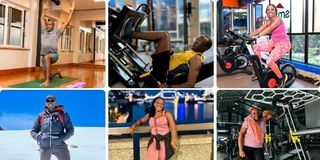
From left (Top): Macharia Njeru, Michael Nawari and Martha Muthoni. (Bottom): Samuel Kariuki, Phyllis Wakiaga and Esther Shisoka.

Photo credit: Pool | Nation Media Group

Spend time with a selection of articles that resonated with our readers last year, spotlighting fitness and wellness routines that deliver results.

Macharia Njeru is stronger, sharper, and more energetic than he was at 30. His workout begins at around 6.30 am. For an hour, he trains intensely every three or four days without fail.

The results? Remarkably flexible and agile (for a man his age), and has an upright gait. “If you saw me walking from behind, you would think it’s a young man,” Macharia says.

The discipline manifests in two ways: he never skips a gym session, regardless of where in the world he is, and he has followed the same diet for the last 17 years.

“I only take two meals a day. My meals are timed, and since it hasn’t been sixteen hours since the last one, I will let it pass.”

By 2023, Wambui Masitsa had reached 110 kilos, the heaviest she had ever been.

“I stepped on a weighing scale one day, saw that number, and I thought, ‘No, this is not me. I can’t.”

When she bought her first car and started walking less, Wambui gained even more weight. But that wasn't the only factor—her career as a wedding cake artist made things even harder.

"There was always cake in the house, and I would find myself biting into it here and there," she says.

Like many people struggling with weight loss, Wambui had tried every diet under the sun. The Dukan diet, paleo, keto, the cabbage soup diet, the egg diet and intermittent fasting.

What helped was when friend introduced her to a specialist who focused on weight loss through hormone balance.

"That's when I learned about the connection between hormones and weight loss, particularly insulin."

Currently at 68 kilos, Wambui’s focus is on maintaining her weight. "Not all diets work for everyone. You need to understand your body and what it responds to," she says.

For Fridah Keitany, an accountant and financial expert who currently weighs 75 kilos, she never imagined embarking on a serious weight loss journey.

By 2023, she hit 106 kg. The frustration made her turn to hiking and daily walks.

“I started being serious about my weight loss. And how I started first was to do hiking and walking. I joined a group of women in Nairobi West where we could walk together early morning from 5.30am. On Saturdays, I had joined a team that we would do the Ngong Sanctuary for 20 kilometres,” she says.

Later that year, Ms Keitany started her dieting. “I started doing something called banting,” she says.

Like many city dwellers, Julius Ngugi found himself eating late at night, which saw him indulge his extra appetite after long workdays. He hit 93kg, thanks to the eating trait and work schedule.

His solution? Intermittent fasting combined with a ketogenic diet.

Mr Ngugi first experimented with intermittent fasting, which he defines as a time-restricted eating method where you eat within a specific window.

"Intermittent fasting is simply reducing the number of meals you eat and when to eat. I realised that I was eating too early and too late, which was affecting my weight."

They meet up by 6.30 am on Saturdays in Nairobi’s Karen. As the early birds gather, there is laughter, light stretching and the rhythmic bounce of sneakers hitting the pavement. The energy is electric—part anticipation, part camaraderie. For many, these runs are not just about fitness — they are about finding themselves.

Charlie Kamau is one of them. Six years ago, he found himself at a breaking point. Grieving the loss of a loved one, he slipped into depression and turned to alcohol to cope. His days blurred together in a haze—until he found running.

Martha’s journey began with fear. She had lost a friend to high blood pressure and watched another suffer a stroke. Then came her own diagnosis.

Doctors offered her a choice: start statins and long-term medication, or change her diet and exercise if she wanted to live long enough to see her children graduate.

“I was afraid of dying,” she admits. “At least not at 40.” She started running and doing hikes. “It took me two years of hiking and running to lose 22 kilos. I had gotten a little bit slimmer so I was introduced to strength training to build muscles. I run five days a week and strength train four times a week to maintain body balance and physique.”

Now at 50 years, she has the metabolic age of a 30-year-old. 

At 53, Michael Nawari can easily slide his hands under the soles of his feet without bending his knees. Not many of his peers can. And yet nine years ago, when he was much younger he couldn’t touch his own toe nails with much ease.

“I was giant of a man, with an oil tanker of a body, my overweight tummy could rival the yoga ball.” He recalls.

But that didn’t bother him until one day he met a friend in town who loves to shoot from the hip.

“Michael I will be honest with you, you look really bad. That is what he said to me and it immediately triggered a fear. I was 44, weighing 92 kg and the thought of getting to 100 kilos while about to turn 50 now became a bother.”

He started exercising.

“I start my workouts at 4:30 am where I will do a one hour thirty minutes run, about 15 kilometers. By 6 am I will be at the gym where I will strength train for an hour, and will do that for six days a week. I only rest on Sunday.”

 Last year, Peter Kamau trained 360 out of 365 days, missing only five due to travel connections. Even then, he found ways to compensate doing exercises in airports during layovers.

A decade ago, Kamau was a casual fitness enthusiast. That changed after he transitioned to a vegan lifestyle following personal research and exposure to the Netflix documentary Game Changers.

He says experimenting with both meat-based and plant-based diets revealed faster recovery times and improved endurance on a plant-based foods, enabling him to train consistently without burnout.

Collins Omondi, a fitness consultant says many Kenyans in late 40s, 50s and 60s avoid gyms, preferring golf or other recreational activities.  While not inherently bad, these activities take longer to deliver fitness benefits. Meanwhile, the need for structured exercise has never been greater.

“Nowadays, we need to work out more than ever because of the food that we eat. Most of the food that we're eating now is processed. When they lift weights, your bones become dense, so it actually reverses that process of osteoporosis," Collins explains.

From weight-lifting, one shouldn’t spend more than an hour.

“Working out should be at least 45 minutes and a maximum of an hour. You should not train beyond that because after one hour of workout, your body plateaus and anything else you do is counterproductive.”

At 62, Esther looks like she has managed to slow time down.  Place her among her age-mates and she stands out; her skin carries a youthful glow, smooth and largely untouched by the fine lines that usually announce the sixth decade of life.

For Esther, fitness isn't a resolution made each January or a vanity project undertaken in midlife panic. It's a lifelong companion. She has done strength training using weights, running, karate, and hockey, name it.

Many of them, due to tight schedules, do not find time to work out for physical and mental wellness. They are corporate leaders.

BDLife caught up with bosses who have managed to centre their lives on fitness, despite hectic schedules. Some do heavy lifting in the gym, others simple skipping routines and long walks during daily commutes, while others do yoga three mornings a week, lunchtime gym sessions focusing on powerlifting and CrossFit, weekend tennis matches with their son and regular long-distance running.

Samuel Kariuki, 45, the CEO of Mi Vida, has built a demanding but deliberate fitness routine. He often wakes up as early as 3am on weekends to begin hikes before dawn. Between hikes, he follows a structured training plan that includes two to three runs a week at varying speeds, combined with targeted strength training focused on the lower body and legs. This conditioning is essential for the long, demanding treks he undertakes and helps him consistently return to his ideal weight range of 70–73kg.

Follow our WhatsApp channel for the latest business and markets updates. 

PAYE Tax Calculator

Note: The results are not exact but very close to the actual.